
A New Way to Give: Designing a Shared Donation Platform for ActionAid
INTRODUCTION
CLIENT
ActionAid UK
TIMEFRAME
6 weeks
HARD SKILLS
User Research + Analysis | Market Research | Persona Creation | Empathy & Experience maps | User Stories and Flows | Wireframing and Prototyping | Usability Testing | Visual Design
ROLE
UX Research and Product Design
TOOLS
Figma, Figjam, OtterAI, Trello
SOFT SKILLS
Stakeholder Management | Teamwork | Active Listening | Empathy | Managing Uncertainty
PROJECT OVERVIEW
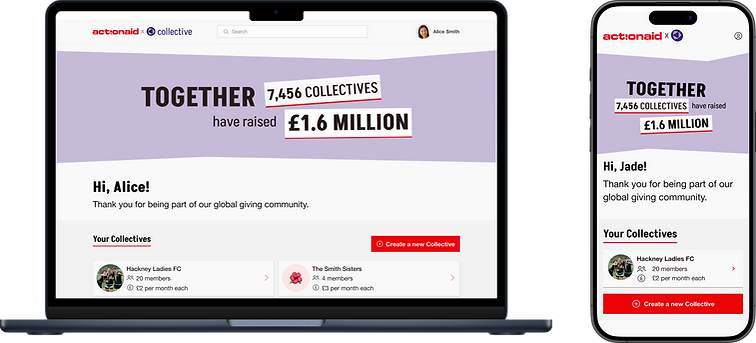
SNAPSHOT OF FINAL DESIGNS

Make a big impact, without the financial burden
Small contributions add up to real change. Join forces with others to give in a way that’s meaningful and manageable.
Create positive change, with those who matter most
Come together with friends, family, or your community - to create real change. Giving is more meaningful when you do it side by side.


See Your Collective Impact Grow
Track how your group’s contributions make a real difference - turning donations into tangible change and supporting ActionAid’s mission to end poverty.
Snippet of client feedback:
We were impressed with the work, research, creativity, and consideration that was put into our creative brief and we were very pleased with the outcome and excellent presentation. The value achieved in the short space of time was remarkable (...) we would highly recommend Sophie Witt.
KICK OFF
A global charity fighting poverty
ActionAid is a global charity dedicated to empowering women and girls living in poverty. It strives to end violence and break the cycle of poverty, ensuring that all women, everywhere, have the freedom to shape their own future.


THE PROBLEM
Recurring donations are in decline
Recurring donations are important for a charity because they:
1. Provide charities with a predictable source of income.
2. Allow the planning of long-term projects.
3. Enable charities to allocate resources more efficiently.
THE CHALLENGE
How might we boost regular giving?
ActionAid needed a new digital product to boost recurring donations and improve donor retention.
I was excited that the brief explicitly encouraged us to be creative and “think outside the box”.
Stakeholder meeting
I created a discussion guide to structure our stakeholder meeting, uncovering key insights to inform the project’s next steps, including:
USER RESEARCH
Understanding our target audience
Screener survey
I designed a screener survey to identify a diverse mix of donors and non-donors, ensuring well-rounded insights.
1:1 interviews
Using tailored discussion guides, we worked closely as a team to interview 30 participants. We explored motivations, challenges, and behaviors around charitable giving.
Example user interview questions:
-
Please walk me through a time that you have donated in the last year.
-
Can you describe any obstacles you’ve experienced whilst trying to donate?
-
How does donating make you feel?
USER INSIGHTS
Synthesising & analysing data
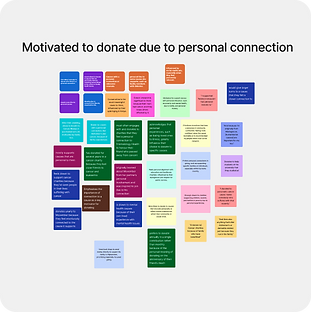
From our user interviews, we gathered over 500 insights and collaborated to create an affinity map, grouping related themes and ideas. This helped us identify emerging patterns, prioritise user needs and pinpoint key pain points.
Affinity mapping process


Key user insights
From the affinity map, key user insights were revealed, including:
PERSONA
Bringing our user to life
Meet Jade, the "Well-meaning Occasional Giver"
Building from the key user insights, I created a persona to ensure the design process was centred around the user's needs, behaviours, and goals.

Thinking from our user's perspective
To delve deeper into the minds of our audience, I created an empathy map to gain deeper insight into the user's thoughts, emotions, and motivations.
The empathy map is based on this scenario:
Jade hears from a friend that in some areas of the world, girls don’t go to school on the week of their period because they don’t have access to sanitary products.

Guided by our research, we framed key design challenges using ‘How might we’ questions:
How might we...
-
Make recurring donations feel more affordable?
-
Increase the sense of personal connection within donors?
-
Foster a sense of community for donors?
-
Show donors the tangible impact of their contributions?

Rapid ideation
I ran a ‘Crazy 8s’ brainstorming session, rapidly sketching solutions in timed 8-minute sprints to generate diverse design concepts.
Photo: Crazy 8 ideas laid out on a board to refine the best.
Three potential ideas


Why we pursued the Shared Subscription idea
This idea felt like a winner because it fit within the constraints, aligned with ActionAid’s goals AND addressed all of the key points from our research:
Think of it like that gym buddy - a good friend keeping you accountable for your good intentions. You are in this together.
STAKEHOLDER CHECK IN
Aligning with our stakeholder
Before advancing the Shared Subscription concept, we met with the ActionAid team to confirm feasibility.
We learnt that funds must be for general use, which would guide our design of the impact section.
MARKET ANALYSIS
Exploring the competitive landscape
Before designing the Shared Subscription concept, we conducted a competitor analysis to identify strengths and gaps in existing individual regular giving models.
Product-market fit?
We found that donation models across the sector are exclusively focused on individual contributors, leaving a gap for collaborative giving.
We saw a unique opportunity - no other charity offered a shared donation scheme.

STRATEGIC THINKING
Defining the design approach
Early stages
To establish a strong foundation, we began by mapping out user flows and wireframes on paper. This allowed us to rapidly explore different concepts before transitioning to digital iterations.
We designed the product to enable small groups of friends or family to:
-
Create a group for shared contributions.
-
Invite others to join seamlessly.
-
Track the group's total impact over time
Sketching out user flows:

User flow: create a group donation:


Paper wireframes:
Low fidelity Figma wireframe:

DESIGN CHALLENGES
More complex than we thought...

Testing early prototypes revealed greater complexity than expected.
We tackled key design challenges, refining the product into a more user-friendly solution.
Iterations that improved the product
The design pivot that unlocked potential...
The initial idea: A group of friends could collectively donate £10 per month, splitting it equally.

Scaling for impact
This breakthrough meant our model wasn’t just for small groups of friends - it could scale to larger groups of people.
Imagine a whole football club joining...

Or a local community group...

Or an entire company...

VISUAL DESIGN
Ensuring a consistent and cohesive UI
A design library was established to maintain uniformity across user flows and enhance the efficiency of the design process. Built upon ActionAid's brand guidelines, font and colour libraries were developed in Figma to ensure cohesion with their visual identity.

HIGH FIDELITY
Demonstrating key user flows
RESULT
A first-to-market product
Unlike traditional charity models that rely on converting individual donors, Collective lightens the load for ActionAid as it focuses on user-driven onboarding.
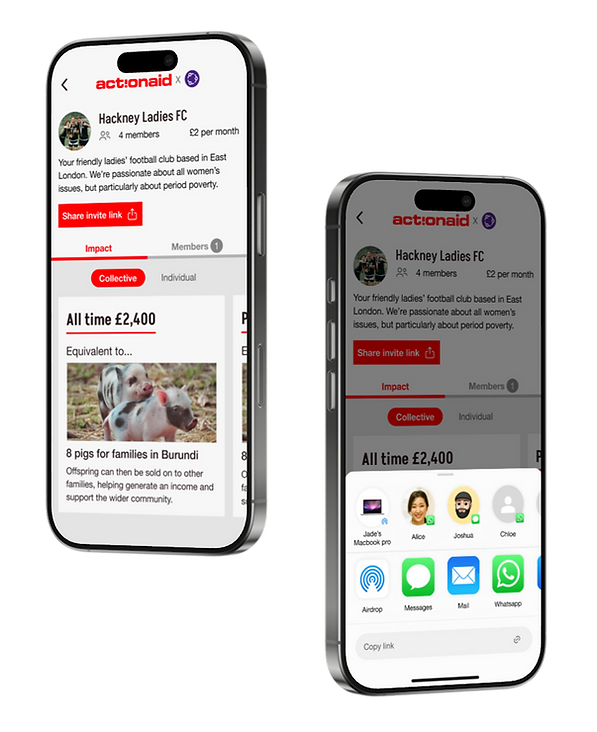
Key benefits:
Imagine a widespread network of givers, all collectively inspiring each other to continue giving.
IMPACT
Measuring success
To assess the impact of the shared donation platform, I established key performance indicators to track and analyse:
NEXT STEPS
Looking ahead
This project was both insightful and rewarding, but there’s always room for deeper exploration.
If I had more time, I would focus on:
Exploring optimal payment structures – Should group members contribute equally, or does flexibility drive better engagement?
Analysing donation limits and retention – How do maximum donation caps affect long-term donor commitment?